Blog
Contact

This dessert is like that girl in high school who was gorgeous and smart and popular: it has it all, in a way that seems too good to be true. The granita is good enough to crave and good enough to eat every night– but low enough in calories that you can do so without waistband consequence. As if that weren’t enough, it is also incredibly easy to make. So feel free to hate little Miss Perfect (whose looks did not age well, by the way, and who is bitter and resentful that life didn’t stay as perfect as it was in good ole high school)– but love this granita with all your heart.

Print Options

Strawberry, Red Wine and Basil Granita

1/2 cup water

1/3 cup sugar

1/4 cup red wine

16 ounces strawberries (about 4 cups)

1 tablespoon chopped fresh basil (plus leaves for garnish)

1. Combine water and sugar in a small saucepan; bring to a boil, stir, and immediately reduce heat to simmer. Stir until sugar is dissolved, about 2 minutes. Remove from heat, stir in wine and let stand.

2. Remove stems from berries and puree in the food processor until fairly smooth. Combine with sugar-wine mixture and basil and transfer to a shallow baking dish (9 x 7 or 8 x 8). Place in freezer draped loosely with plastic wrap. After a couple of hours and occasionally thereafter, scrape the freezing mixture with the tines of a fork to loosen and crumble. Allow to freeze overnight.

3. Before serving, scrape with a fork one final time until mixture resembles finely shaved ice. Spoon into wine or martini glasses and garnish each serving with a sprig of basil.

Makes 4 servings

Nutritional analysis for each serving: 89 calories, 1 g protein, 21 g carbohydrates, 2 g fiber, 0 fat, 2 mg sodium

{ 3 comments }

Mother Bird

May 12, 2012

This is how much a mother loves her young.

A bird built her nest just a foot beyond the wooden fence in my yard and about five feet off the ground. It was not a wise place to build the nest, but a mother needn’t be smart to love brilliantly.

We watched from a distance as she sat on her nest; I waited for her to fly away so I might peek at her eggs. But mother birds can be very patient; she sat unmoving on her nest. (Although I wonder which species is truly more patient: the human, who carries her young for nine months, or the bird, who sits on her eggs for just twelve to fourteen days. Still, humans can read and work and ready the nursery during that time; birds just sit and stare and venture off now and then for worms.)

I had waited as long as I could. Slowly, stealthily (for a human), I made my way closer, hoping to at least get a picture of her on the nest. When I got close enough to stick my camera, like a big mechanical nose, right in her business, she flapped angrily and flew several feet up and away.

From her perch she watched me hover over her luminescent blue eggs, in fear, no doubt, that I was a vulture or a bluebird, out to steal them away.

I wanted only to capture their beauty, their jewel-like glow, with my camera. But I am a clumsy human on a wobbly step stool with a feeble understanding of camera mechanics. I snapped away on and off throughout the day, never quite getting the shot I wanted. As the sun lowered in the sky, the mama bird made her way closer to me when I stood near the nest; perhaps she had gotten used to me. Better yet, maybe she realized I was not a threat.

Two days later, three of the eggs had hatched. The fourth egg took still another day. (It happens; my second child chose to extend the gestation period beyond the usual nine months).

I can’t stay away from the nest. Three more days pass, and those hideous hairless creatures that look like a cross between amoebas, E.T., and miniature dinosaurs are growing tufts of feathers on their rear ends (do birds have tushies?) and crowns. They look like they are playing dress-up in tutus and headdresses. And as though they are sporting great big, bulgy sunglasses: birds are born blind and have enormous, creepy-looking blue-ish black bulges where their eyes will be.

The mother bird hates me and I don’t blame her.

As soon as I come too near, the forces of nature compel her to fly away and watch, yet again, as I stick that big black clicking, beeping tube right close to her hungry babies. She squawks and flaps and jumps from branch to branch to branch before deciding on a nearby tree as I rustle leaves all around her precious babes. I am torturing her.

For two days, I try to capture the moment when the babies lift their heavy heads up on those scrawny necks, opening their enormous mouths in angry hunger. It is the desperate cry that makes mothers everywhere ache to feed the young: I would carry worms to soothe these babies. Instead, I snap away, selfishly hoping to capture those four long necks and gaping beaks sticking up above the nest.

Tonight I just can’t leave. The babies seem to have developed their sense of hearing; they are more reactive to the world around them. My dog barks and they startle and reach up. They snuggle down again, and Mama calls to them. They stretch back up, yearning, shaking in anticipation– and collapse again, as though they’ve just crossed the Serengeti by foot.  I retreat guiltily—they need their mother.

Minutes later I return, like a child who knows better than to sneak into the cookie jar just before dinner. I know the sun will set soon, and then I promise I will leave them alone. But I am so close to getting that perfect shot of all four of them reaching and quaking in anticipation of the food and warmth their mama will bring. Just one last shot…

She calls to them, or to her troops in nearby trees. She shrieks, and I think it may be at me. I’ll stop in just a minute—really, I will. I fiddle with the settings on my camera and keep trying. And as I stand on the stool, concentrating with all my might to keep still enough to get a clear, crisp photo, she swoops right by my ear—so close I feel a breeze from her wing and so fast I hear a whoosh.

I am five foot two, and look even taller when standing on a stool. I have arms that are easily four times as long as her wings, and I carry ominous looking equipment that may be capable of doing great harm. And yet this mama bird will attack me to protect her babies.

That’s how much a mother loves her young.

{ 9 comments }

There is a moment in life when everything is perfect. It might be when you are lying in bed just after; you inhale the sounds and smells of pure contentment. It is in the rustle of crisp autumn leaves and the clean air that dances in through the window and tickles your skin. It is the warm arm that pulls you close; you are beloved.

Or were you sitting on a beach, watching your two golden-skinned children chatter away in earnest pursuit of their very important castle-with-a-moat? They are pure and beautiful and this feels religious.

I have been honored with many such moments in my life, but not one of them happened last week.

If I believed in karma, or divine destiny, or that there is a reason for everything, I would feel certain that my family is about to have a a dump truck full of good fortune pull up our cosmic driveway and unload a heap of good stuff. My sisters and I would leap into it the way we used to dive into the piles of leaves Dad raked. We’d throw it up in the air and let it shower down on each other and on Dad, and it would be one of those moments. One of those moments that we did not have last week.

It was overcast on Thursday, the day of my Uncle Sandy’s funeral. The grey sky settled in my Dad’s eyes and the dingy clouds hunkered down on his shoulders. I watched him, wishing my mother was there for him. For all of us.

My Uncle Sandy will never call me “doll” again. My Dad doesn’t call anyone that, so I know Uncle Sandy must have picked it up after he moved from Cleveland, where they grew up, to New York. When I was a girl, I thought “doll” sounded very New York Broadway-ish, like Guys and Dolls. I didn’t mind that Uncle Sandy called all the girls and women doll: I liked that I was on his list. At the top of his list, though, was my Aunt Alice. Alice is a beautiful, elegant woman, and Uncle Sandy looked at her like she was a treasure. But most of all, I loved Uncle Sandy’s funny, mischievous moments: his eyes would get a certain sparkle, and then his smile would break through, and it would stretch wide across his face, clear over from one ear all the way to the other. The only other person I have ever known with a grin nearly that big is my Dad.

Dad will have his mojo back soon. He’s the kind of guy who can get punched in the (figurative) gut, lie there for a moment or two, then pick himself up, brush off his pant legs, stand still for just a moment longer to process, and then take a step forward to explore something more interesting.

One thing he will always head towards is a platter of rugelach; he finds them nearly irresistible. There has been an abundance of rugelach in his life lately: for whatever reason, nearly everyone brings rugelach when they pay a condolence call. In fact, the 11th commandment may well be: When death visits thy family or neighbor, thou must bringest rugelach.

Print Options

Rugelach

Note: for a visual step-by-step, see the photos that follow the recipe.

Make the dough one day in advance and allow it to chill overnight.

1 1/2 cups flour

1 teaspoon dry yeast (about 1/2 a packet)

1 stick (1/4 pound) unsalted butter at room temperature, cut in bits

2 large egg yolks

1/2 cup sour cream

1/2 cup very finely chopped walnuts

1/2 cup sugar

1 teaspoon cinnamon

1/3 cup currant, apricot or peach jelly

1. Make the dough: combine the flour and yeast in a bowl. Cut in the butter with a pastry fork or two butter knives until the mixture looks like sand.

2. Beat the egg yolks lightly with a fork and combine with the sour cream. Stir into the flour mixture. Divide into 6 small balls and wrap each in plastic wrap. Place in the back of the refrigerator (the coldest part) overnight.

3. Preheat oven to 350F. Line two baking sheet pans with parchment paper.

4. Combine the nuts, sugar and cinnamon in a bowl. Warm the jelly  about 10-20 seconds in the microwave– just enough to become easy to whisk until smooth.

4. Sprinkle your work surface with 1 tablespoon of the nut mixture and spread it out into a 7-inch circle. Place 1 ball of dough in the center of the circle and press it lightly with your hand into a 3-inch disk. Turn the dish over and drape with a 1-foot long piece of plastic wrap. Working on top of the plastic wrap, roll the dough into a 6-inch circle. Remove the plastic wrap and flip the dough over. Sprinkle with 1 tablespoon of the nut mixture and cut into 8 wedges.

5. Place a drop of jelly about the size of a green pea at the wide end of each wedge. Starting at the wide end, roll each wedge snugly to enclose the filling. Repeat this process, using all the dough. (Keep each ball in the refrigerator until you are ready to roll it out). After all the rugelach is formed, roll the cookies in the remaining sugar nut mixture to lightly coat the outside. Place in a single uncrowded layer on the lined sheet pans and bake 15 minutes, until golden. (The cookies will leak while they cook).

6. When the cookies come out of the oven, either place them a clean piece of parchment or move them slightly on the pans so they don’t stick to the leaked jelly as they cool.

Makes 48 cookies


The nuts should be finely chopped. To give you an idea of size, that is the blade of my chef’s knife in the right hand corner. The nuts may be chopped by hand or in a food processor.

The dough is rolled out on a bed of the sugar-nut mix.

First flatten the dough with your hand into a 3-inch disk…

…flip the dough over, drape with a sheet of plastic wrap and roll it out…

…into a 6-inch circle.

Cut the dough in 8 wedges; place a dot of jelly the size of a pea at the edge of each wedge and sprinkle 1 tablespoon of the sugar-nut mixture over the dough.

Start at the wide end of the wedge and roll the dough up.

It looks like rugelach!

Roll the formed cookies in the remaining sugar-nut mixture and place them on a cookie sheet lined with parchment paper. Bake for 15 minutes at 350 degrees.

The jelly will leak, but that’s okay. When you take the cookies out of the oven, replace the parchment paper or move them slightly on the pan so they don’t stick as they cool.

And we’re cooling…

And now it’s time to eat.

{ 6 comments }

Most fish has some kind of caveat attached to it. It may be concern about contaminants; escapees from the farm that threaten the wild population; or it is endangered. All these reasons to not eat seafood — while nutritionists and health researchers tell us to eat more.

Enter arctic char, the fish for the conscientious consumer with a discerning palate. As much as that sounds like a line out of Don Draper’s playbook, it is true. Here is a fish, at long last, you can love freely and with abandon because it is:

* good for you: it is high in omega-3s and very,very low in contaminants. (It is a great choice for pregnant women).

* good for the earth: almost all the arctic char you see comes from eco-friendly fish farms. It is rated as a “Best Choice” by the Monterey Bay Aquarium Seafood Watch program. (Click on the link to download their handy safe seafood chart as an app for your smart phone or printable wallet sized card.)

* mildly flavored with a slightly rich, flaky texture– and it isn’t “fishy”.

* reasonably priced compared to other fish. (My local market sells it for about $7.99 a pound, and on sale as low as $5.99).

* incredibly easy to cook right. Oh, and it cooks fast, too. (You can get dinner on the table in less than 15 minutes.)

Print Options

Arctic Char with Mango-Tomato Topping

You can also serve arctic char with a simple tomato, basil and olive topping or a remoulade (a mayonnaise-based topping that comes together in about two minutes).

4 plum tomatoes (about 12 ounces), diced

1 mango, diced

1/4 cup chopped scallions

1/4 cup basil, cut in thin shreds

1 teaspoon orange zest

3/4 teaspoon, divided

4 6-ounce arctic char filets

1/8 teaspoon black pepper

1 tablespoon olive oil

1. Combine the plum tomatoes,  mango, scallions, basil, orange zest and 1/4 teaspoon of the salt in a bowl; set aside.

2. Season the fish with the remaining 1/2 teaspoon of salt and pepper.

3. Heat the oil in a large nonstick skillet over medium high. Add the fish, skin side facing up, and cook 2 minutes, or until golden, Turn and cook 3 minutes, until fish is cooked through and skin is crisp.

4. Serve with the mango-tomato topping.

Makes 4 servings

Nutritional analysis for each serving: 245 calories, 30 g protein, 16 g carbohydrates, 3 g fiber, 7 g fat, 2 g saturated fat, 541 mg sodium

{ 3 comments }

As I slaved away (!) at my desk early Sunday evening, my husband whipped together a lovely dinner which included this dish. When I wandered into the kitchen and saw it, I just had to take a picture and share.

Being married to a gifted chef makes life tasty in oh-so-many ways. (He, on the other hand, may occasionally find it a tad frustrating to be married to someone who is compelled to document his creative endeavors– especially when it means we can’t eat dinner until I finish photographing.)

Roasting beets takes very little effort and the pay-off is enormous. For less than 15 minutes of effort (they cook unattended for about an hour) you get sweet and intensely flavored beets that keep well in the refirgerator for several days. Serve wedges tossed into a green salad with blue cheese or on top of a prepared pizza crust with creamy mozzarella, basil, feta and white beans.

Print Options

How to Roast Beets

These instructions are based on beets that are about 2 1/2-inches in diameter. Your cooking time will be more or less, depending on the size of the beets.

1. Preheat oven to 375F.

2. Cut off stems and leaves. (the greens are delicious; reserve them and cook as you would any other leafy green such as kale, collard, or chard). Rinse beets under cold running water; pat dry. Wrap beets together in a single layer in foil; place on roasting pan or baking sheet. Roast 1 hour, or until the center is tender when poked with a fork. Remove from the oven, open the packet and let the beets cool.

3. Peel the beets. You may wear gloves (or wash your hands right away in soapy water). Use a paring knife to help slip the skins off– they come off quite easily.

Roast Beet, Feta, Cucumber and Bell Pepper Salad

4 beets, roasted (see instructions above)

1 red bell pepper, cut in 1/2-inch dice

1 orange bell pepper, cut in 1/2-inch dice

3 Persian cucumbers, cut in 1/2-inch dice

1 tablespoon lemon juice

1 tablespoon white balsamic vinegar*

2 tablespoons extra virgin olive oil

1/2 teaspoon salt (more to taste)

1/4 teaspoon black pepper (or to taste)

1/3 cup crumbled feta

1. Cut the beets into 1/2 inch dice and combine with the bell peppers and cucumbers. In a small bowl, combine the lemon juice, vinegar, olive oil, salt and pepper; toss with the vegetables and gently stir in the feta.

Makes 6 servings

Nutritional analysis per serving: 122 calories, 4 g protein, 13 g carbohydrates, 4 g fiber, 7 g fat, 2 g saturated fat, 362 mg sodium

* regular balsamic may be used: the white balsamic simply helps preserve the colors better.

{ 5 comments }

After last week’s warning against  ”deadly” chicken breasts by Physicians Committee for “Responsible” Medicine (the quotation marks are mine), of course all I want to eat is chicken breasts.

The dish below takes just a few minutes to throw together, then bakes unattended for about 50 minutes. The chicken is moist, tender and juicy. You can double the recipe (use a bigger baking dish and allow for a little extra cooking time) and it makes great cold or warm leftovers. It’s also really well-suited for entertaining, because it can be assembled in advance and then baked last minute, or completely cooked and re-heated.

I used frozen artichoke hearts to keep this a simple fuss-free meal suitable for a weeknight meal. But  artichokes are in season right now; when you have time, you can make it even better with fresh baby artichokes.

I love all things artichokes. To see my step-by-step pictorial on how to prepare and eat artichokes, click here. I also came across this great looking recipe on the MyRecipes* web site for an Artichoke Galette, which I am dying to try. For stovetop chicken with lemon sauce made with boneless breasts, click here.

Print Options

Roast Lemon Chicken Breasts with Artichokes and Potatoes

1/4 cup lemon juice

1 tablespoon extra virgin olive oil

1 teaspoon dried oregano

1/2 teaspoon dried marjoram

4 medium red bliss potatoes (1 pound) each cut in 8 pieces

1 9-ounce box frozen artichoke hearts, thawed

1 teaspoon salt, divided

2 pounds bone-in chicken breasts, cut in 4 pieces

1. Preheat the oven to 425 degrees. Coat a 9 x 7 inch baking dish with cooking spray.

2. Combine the lemon juice, olive oil, oregano and marjoram in a large bowl. Add the potatoes and artichokes; toss. Use a slotted spoon to lift the vegetables out of the lemon juice mixture and transfer to the baking dish; sprinkle with 1/2 teaspoon of the salt.

3. Whisk the remaining 1/2 teaspoon of salt into the lemon juice mixture in the bowl. Add the chicken and toss well to coat.  Place the chicken in the baking dish, drizzle with any remaining lemon juice and bake, basting occasionally, until chicken is cooked to 160 degrees and potatoes are tender, about 50 minutes.

Makes 4 servings

Nutritional analysis for each serving: 408 calories, 43 g protein, 24 g carbohydrates, 6 g fiber, 15 g fat, 4 g saturated fat, 732 mg sodium

* That’s the site where my column, Ask the Expert, appears daily. Feel free to pay me a visit there and write in with your cooking question. If there is a cooking question on your mind, it’s probably on other cooks’ minds, too.

{ 8 comments }

The Huffington Post published a nutrition quiz from the Physician’s Committee for Responsible Medicine (PCRM) that warns against the perils of consuming chicken, eggs, salmon and milk.

PCRM, an organization with a reassuring name that belies its radical agenda, advocates an extremely low fat (10-15%) vegan diet. They vigorously promote an anti-meat, anti-poultry, anti-seafood, anti-eggs and anti-dairy diet through media outreach, legislative lobbying and small sensationalized studies like this one debunked by experts in the New York Times last week.

The quiz HuffPo ran looked innocent enough, but it was designed to strike fear in our hearts—and kitchens. The take-away messages from the ten questions are below. (Hint: #10 is where things get really juicy).

1. Skim milk has the same number of calories as cola.

So what? That doesn’t make skim milk a bad choice or cola a good one. We need calories, and we should get them from foods that have nutritive value, like milk. Oh, I get it: PCMR thinks milk is bad for us.

2. Cheese and steak have the same amount of cholesterol.

We are no longer living in the 1990s, when scientists believed eating cholesterol (dietary cholesterol) raises the cholesterol in your body (serum cholesterol). Science has progressed in the intervening decades, and it is now a well-accepted fact that saturated fat has a far more profound impact on raising our serum cholesterol. In other words, lower your intake of saturated fat, not dietary cholesterol to reap heart health benefits. PCRM draws a comparison between steak and cheese to drive home the idea that cheese is as bad for our health as –gasp– red meat.

3. Cheese is 70% fat.

Yup, that’s what makes it taste so good.

4. Frequent consumption of hot dogs and bacon makes it more likely you will get colon cancer.

Does anyone think eating hot dogs and bacon every day is good for you? On the other hand, an occasional strip or two of bacon isn’t going to land you in the oncologist’s office. But in the quiz, PCRM writes,Processed meats such as hot dogs, bacon, and deli meats are so closely linked to colorectal cancer that the recommended intake is none.” PCRM may recommend we eat none, but the USDA says occasional consumption is okay.

5. Women who regularly eat soy have lower cancer risk.

This is a gross oversimplification of what has become a very thorny issue. Initially, researchers looked at Asian populations where soy consumption is high and breast cancer occurrence lower than ours. But there are other differences in lifestyle and diet, too. More controlled studies (as opposed to population studies) have shown mixed results. We currently do not know if soy is protective or actually harmful when it comes to hormonal cancers. One well-known soy researcher I spoke to said that if his wife were diagnosed with breast cancer he would want her to stop eating all soy foods.

6. Salmon has cholesterol and fat

In case you have been living in a cave, most of the fat in salmon is really good for you—and is difficult to get in meaningful quantity from plants.

7. An egg has more cholesterol than a Big Mac.

We went over the whole cholesterol thing above. But PCRM is implying an egg is as unhealthy as a Big Mac, so I’d like to point out that a Big Mac has 540 calories and a large egg has 71; a Big Mac has 29 grams of fat and an egg has 5; and a Big Mac has 10 grams of saturated fat and an egg has 2. They aren’t even in the same nutritional solar system.

8. Milk, beans and broccoli are all high in calcium.

Point well-taken: dairy is not the only dietary source of calcium.

9. Fish and beef have no fiber.

Right, and spinach and tomatoes barely have any protein, but we don’t say they are unhealthful. Different foods contribute different nutrients, plain and simple.

10. A skinless roasted chicken breast has more calories per ounce than soda or white rice.

It’s a silly comparison, given their relative nutritive value, but at least it is accurate. But not this, which follows: “The percentage of fat from roasted, skinless chicken breasts is about the same as steak, contributing to its high calorie content.”

Not true. Period.

I emailed PCRM to point out the factual mistake. I supplied nutrition data for the chicken breast and porterhouse steak. Their director of nutrition education, Susan Levin, M.S., R.D., emailed back, defending the statement. She suggested two leaner cuts of beef would make a better comparison: eye round (which is not served as a steak) and top sirloin. Okay. I emailed her a comparison of the nutrition facts for skinless roasted chicken breast and top sirloin steak: chicken breast gets 20.6 % of calories from fat, 5.8% of which are saturated. Top sirloin gets 30.9% of calories from fat, 11.8% of which are saturated. Those are not “about the same” percentage as PCRM states on the quiz.

I also pointed out to Ms. Levin that 74.7% of the calories in almonds are fat, because she does not object to nuts. (For the record, neither do I, but she skewered chicken for its high percentage of calories from fat, so it seemed worth mentioning). And then she wrote this back to me:

“Doctors who prescribe “chicken and fish” instead of red meat to sick patients are simply kidding themselves and not doing their patients any favors. As long as people think they are going to improve their health by eating chicken, they are going to end up returning to their cardiologists wondering what went wrong, if they make it for the return trip alive.”

I was stunned. She used outright scare tactics to promote her self-righteous dietary extremism. If you eat chicken, you might not make it back to the doc alive?!

It is one thing to talk about your beliefs and it is another to present incorrect and misleading information in a very public forum like the Huffington Post, and then defend it by suggesting that eating skinless roasted chicken breasts can lead to death. Ms. Levin has every right to believe in and follow a vegan diet—but why try to terrify and threaten others into doing so?

This post is not a diatribe against vegans or veganism. The choice individuals make about their diet is theirs alone. (Besides, many vegans I know eschew eating animals for moral, not health reasons. I have as much business in that part of other people’s lives as I do in their religious choices.) This is about misleading, untrue information presented as fact. It is about a major media outlet not bothering to retract factually incorrect information*. It is about frightening people into following an agenda; it is about sending a loosely veiled message of “Do this or die.”

And on that note, ladies and gentleman, I have an unusual craving for a great big glass of very naughty ice-cold skim milk.

* I also wrote to the HuffPo editor to point out the incorrect information. She went back to PCRM, who stood by the original claim. And then, I was so incensed, I did something I never do: I offered to write a rebuttal for free. HuffPo declined. (To any of my editors reading this: the whole “free” thing was a one-timer, and we’re past the expiration date.)

{ 15 comments }

Sometimes a girl just has to have eggs. And brunch. And something that looks divine but maybe makes up for a bunch of days of indulgent eating (Only 239 calories. Really). Maybe I should call these my transition-to-getting-back-on-track eggs, because they aren’t so spartan I feel like I am doing the D-word, but they have the balance of protein and carbs and fat that will keep me full for a while, and they taste so good I’ll nearly trick myself into thinking I’m living like Dionysus.

Print Options

Baked Eggs with Spinach, Bacon and Potatoes

Prepare the bacon, potatoes and spinach the night before. In the morning simply combine the filling with the eggs and bake.

4 strips center-cut bacon

2 medium red potatoes, (8 ounces total), cut into 1/4-inch dice

4 cups baby spinach

1/8 teaspoon nutmeg

4 tablespoons grated Parmesan cheese

8 large eggs

1. Preheat the oven to 375 degrees. Coat the inside of 4 (6-ounce) ramekins with cooking spray.

2. Cook the bacon in a large, nonstick skillet over medium high. Transfer to a plate lined with paper towel; crumble bacon when cool.

3. Add the potatoes to the skillet and cook, stirring occasionally, until well browned and tender, 12 to 14 minutes. Add the spinach and nutmeg, and cook, tossing, until just wilted, 2 minutes. Combine vegetables with bacon and spoon the mixture into the ramekins. Add 1 tablespoon of cheese to each.

4. Beat eggs with fork until fairly smooth and pour into the ramekins. Place on a tray and bake about 20 minutes, until the eggs are set — a toothpick inserted in the center will come out clean. Serve immediately. Makes 4 servings.

Nutritional analysis for each serving 239 calories, 18 g protein, 13 g carbohydrates, 2 g fiber, 13 g fat, 5 g saturated fat, 402 mg sodium

{ 11 comments }

The most difficult part about cooking for Passover is, of course, cooking without leavening. But the second biggest challenge is also a biggie: you need to prepare a meal completely in advance that can be held for however long your Seder lasts (ours is 15 minutes, but many take two hours) — and then be ready within nanoseconds to feed your starving family and friends. Of course, the same could be said of a great deal of entertaining: the challenge is to get as much done in advance as possible so that when it is time to eat, you don’t disappear into the kitchen for ages and miss all the time with your guests. (Or worse: cook everything in advance and reheat it until it turns to wood chips and saw dust.)

Slow cooked meat, like brisket and pot roast, is ideally suited to Passover. You cook it forever to begin with, and then forevermore when you heat it back up. And it’s none the worse for wear. Chicken soup can be made entirely in advance and kept warm over a very low flame. Just before serving, the matzo balls, also made in advance, get plunked in and cooked for only as long as it takes to warm them. Vegetables and side dishes can be a little trickier. I like to roast vegetables on a sheet pan in advance, cooking them slightly under. During the seder, leave them out at room temperature; put them in the oven while you eat your first courses (soup and gefilte fish, perhaps). I developed the farfel kugel recipe below to withstand being made in advance and re-heated. I love almost everything with artichokes; I was happy to see when I taught it to my Do-Ahead Passover class at ICE (Institute of Culinary Education)* last week it was a hit.

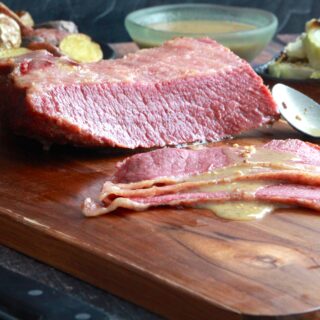
Stovetop Brisket This incredibly easy brisket may even be made several days ahead– or longer and frozen. It re-heats beautifully…but even more importantly, it is, quite simply, delicious. (I don’t just make it on Passover!)

Roast Spring Vegetables Make these in a baking sheet pan with low sides to ensure they get an intensified, almost caramelized flavor.

Chicken Soup with Matzo Balls This is simmering on my stove as I write. My house smells great; I think my dogs are in food-heat.

Pomegranate Poached Pears After a big Passover meal, these pears (along with a macaroon or two) are just the ticket.

Happy Pesach!

Print Options

Matzo Kugel with Vegetables

Make the kugel the day before. To re-heat, pour an additional 3/4 cup broth over it and warm in a 350F oven for about 30 minutes. The top should get pleasantly crunchy. If it begins to darken, lay a piece of foil loosely over the top.

5 tablespoons extra virgin olive oil, divided

3 medium onions, chopped (4 cups)

8 ounces sliced mushrooms

7 eggs, divided

1 16-ounce box matzo farfel

2 9-ounce boxes frozen artichoke hearts

5 carrots, cut in 1/4-inch dice (2 cups)

1/2 teaspoon thyme

1 1/2 teaspoons salt

1/2 teaspoon black pepper

1 cup parsley, chopped

4 cups low sodium chicken or vegetable broth (plus additional for re-heating)

1. Coat an 11 x 7 baking dish with cooking spray. Heat the oven to 350 degrees.

2. Heat 2 tablespoons of oil in a large nonstick skillet over medium; add the onion and cook, stirring occasionally, until soft and golden, 20 minutes. Transfer to a large bowl.

3. Add the mushrooms to the skillet; cook 5 minutes, stirring occasionally, until browned. Transfer to the bowl.

4. Add 2 tablespoons of the oil to the skillet; add the artichokes and carrots and cook, stirring occasionally, until carrots are tender, 10 minutes. Transfer to bowl.

5. Beat 5 of the eggs with a fork; toss with the farfel. Add 1 tablespoon of oil to the skillet; add the farfel and cook, stirring often, until it is toasty, about 5-6 minutes. Transfer to the bowl; stir in the thyme, salt, pepper and parsley and transfer to the baking dish.

6. Combine the 2 remaining eggs with the broth and pour over the farfel. Bake 45 minutes until the center is no longer wet.

Makes 12-16 servings

*Several of you have asked about my upcoming schedule at ICE. While it is not yet published on the ICE website, my classes will be listed here (under the calendar tab on this website) within the next few days.

{ 5 comments }

Lots of people don’t like tofu, and I get that. People who love tofu say things like “You can’t dislike tofu–it has no flavor of it’s own” and “It just absorbs whatever flavors it is paired with”. I disagree. Tofu can take on the flavors around it, but it has its own characteristics, too.

Just to be clear, I like tofu. I like it prepared many different ways– some of which people who don’t like tofu would abhor (because the custard-like texture and inherent flavor are left unmasked). But most of all I like tofu turned into meaty, chewy triangles with a crispy crust. And, I have found, so do lots of people who don’t normally eat tofu. This is Tofu for the Reluctant.

The powerfully flavorful salty, spicy sauce adds to its appeal– for both Reluctants and Lovers. And now, I’m going to pull out the really big guns (in case I havent been convincing enough):  you can have this dish on the table in about 15 minutes.

Print Options

Tofu for the Reluctant

1 16-ounce block firm tofu

2 teaspoons sesame seeds

1 teaspoon honey

2 tablespoons light soy sauce

1 tablespoon fish sauce

1/8 teaspoon crushed red pepper flakes

3 scallions, green parts only, chopped (about 1/3 cup

2 tablespoons sesame oil, divided

1. Drain the tofu and press it; top it with a plate and weigh the plate down with a heavy can.

2. Place the sesame seeds in a large nonstick skillet over medium high heat. Cook, shaking the pan occasionally, until the seeds are light brown, about 2-3 minutes. Transfer to a plate to cool.

3. Make the sauce: combine the honey, soy sauce and fish sauce in a bowl; stir to dissolve the honey. Add the sesame seeds, scallions and crushed red pepper.

4. Turn the tofu on its side and cut into four even slices. Lay the slices back on top of each other and cut diagonally across in quarters to form 16 triangles.

5. Heat 1 tablespoon of the oil in the skillet over medium high. Add half the tofu and cook 4 minutes per side, or until lightly golden. Keep warm in a low oven or drape with foil while you repeat the procedure with the remaining oil and tofu.

6. To serve, spoon the sauce over the tofu.

Makes 3 servings

Nutritional analysis for each serving: 332 calories, 25 g protein, 10 g carbohydrates, 4 g fiber, 23 g fat, 3 g saturated fat, 877 mg sodium

{ 9 comments }